 |
Catalog Search Support |

| (Much of this section is based on Ed Kirby's "East Canaan Iron Chronology: 1739 - 1999"; John Rodemeyer's Scrap Book of North Canaan; material from the archives of Trinity Church, Lime Rock; and a website about the Canaan Mountain Natural Area Preserve ) | ||
| 1739 | Richard Seymour constructs a "bloomery forge" on the south bank of the Blackberry River | |
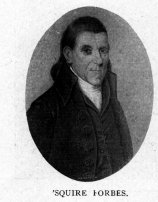
| 1743 | Samuel Forbes, age 14, of Simsbury, CT, moves to Sheffield, MA and works at the Seymour Forge in East Canaan | |
| 1780 | The partnership of Samuel Forbes and John Adam is formed |
(photo from Scrap Book of North Canaan) |
| 1832 | Samuel Forbes Adam, grandson of Samuel Forbes, builds the first blast furnace in East Canaan (known as Forbes Furnace/East Canaan #1). Its location on the Blackberry River is a few hundred yards downstream of the future site of Beckley Furnace. | |
| 1841 | The Housatonic Railroad is completed to Canaan. | |
| 1847 | East Canaan #2, which comes to be known as the John Adam Beckley Blast Furnace, is built by John Adam Beckley, great grandson of Samuel Forbes and partner William Peirce. Base is 30' x 30', initial height is 32'. | |
| 1856 | Major update of Beckley Furnace occurs. | |
| 1858 | The Barnum Richardson Company, of Lime Rock, acquires
Beckley Furnace. They will eventually own eight blast furnaces in the
area, as well as extensive fabricating capacity at their foundries and
works in Lime Rock, where the output from the East Canaan furnaces is taken
for further processing.
 to see photographs from the archives of
Trinity Church, Lime Rock, of William H. Barnum, President of Barnum and
Richardson, and his family, and links to other information about the Barnum
and Richardson families.
to see photographs from the archives of
Trinity Church, Lime Rock, of William H. Barnum, President of Barnum and
Richardson, and his family, and links to other information about the Barnum
and Richardson families. |
|
| 1872 | Barnum and Richardson build East Canaan #3. This furnace will later be known as "the furnace in the field" because of its distance from the Blackberry River, and eventually as "Lower Furnace" because of its position relative to the other furnaces (Beckley and East Canaan #1) | |
| 1880 | Beckley Furnace updated with steam power to supplement the water power used for the furnace blowers. | |
| 1883 | East Canaan #1 (Forbes Furnace) is closed. | |
| 1889 | William Henry Barnum, President of Barnum Richardson Company (and former United States Senator from Connecticut as well as former chairman of the national Democratic Party), dies. | |
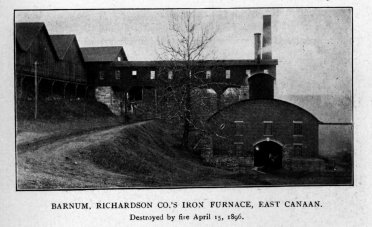
| 1896 | Always a threat in the iron industry, a major fire sweeps the Beckley Furnace area, destroying most of the wooden outbuildings above the charging wall. | |
|
(photo from Scrap Book of North Canaan) |
||
| 1898 | Rebuilding of the complex is sufficiently well along to put Beckley Furnace back into blast. Height of furnace has been increased to 40'. | |
| 1915 | New England Slag Company formed, with the objective of crushing and screening the accumulated slag and potentially incorporate it into concrete. (Some of the abandoned equipment in the woods across Blackberry River may date from this period). | |
| 1917 | Early in the year, Barnum and Richardson Company recapitalized. Later that year, the company declares bankruptcy but continues operations. | |
| 1918-1919 | The United States enters World War I, which greatly increases demand for iron. Barnum Richardson begin construction of a new furnace, known as East Canaan #4, in June of that year. However, the spike in the demand curve is short-lived as the war ends not long after the US enters it. A major salamander at Beckley is removed but furnace efficiency is reduced in the rebuilding process. Beckley closes during the winter of 1918-1919. Construction activities on East Canaan #4 cease in June 1919 without it ever coming into blast. | |
| 1920 | The bankrupt Barnum Richardson Company is acquired by the Salisbury Iron Company. | |
| 1923 | East Canaan #3 goes out of blast in April, leaving East Canaan with no active iron industry for the first time in 184 years. The Salisbury Iron Company suspends operations. | |
| 1925 | Salisbury Iron Company goes into receivership. Sale of thousands of acres of land to the State of Connecticut begins, including what is now most of Housatonic State Forest in Sharon, Housatonic Meadows State Park and state forests on Canaan Mountain and in Cornwall. | |
| 1920s-1930s | Bricks of the casting and blower houses at Beckley Furnace are sold and removed. | |
| 1945 | Charles Rufus Harte calls for saving the Beckley Furnace Stack. | |
| 1946 | The State of Connecticut purchases Beckley Furnace and designates the furnace as "Connecticut's Industrial Monument". Deeds for the property are turned over to the State. | |
| 1978 | Beckley Furnace is placed on the National Register of Historic Places | |
| 1996 | The Committee for the Preservation of Beckley Furnace is
formed. A preservation study report is completed by Ed
Kirby.
 to view the report.
 |
|
| 1998 | The State of Connecticut bonds preservation of the furnace stack in the amount of $250,000 with reconstruction beginning in Spring 1999 | |
| 2002 | The former Paymaster's office and nearby residence are acquired by the State of Connecticut and renovation of the Paymaster's office into an educational center for the Beckley Furnace site begins | |
| July 5, 2003 | Beckley Furnace Educational Center opens to the public for the first time | |
| June, 2005 | New interpretive signs and new signs clearly identifying the Beckley Furnace site are installed and dedicated. | |
| July 15, 2005 | In the course of archaeological excavation of the tailrace of what was earlier believed to be "the" turbine, the Friends of Beckley Furnace uncover a second turbine. | |
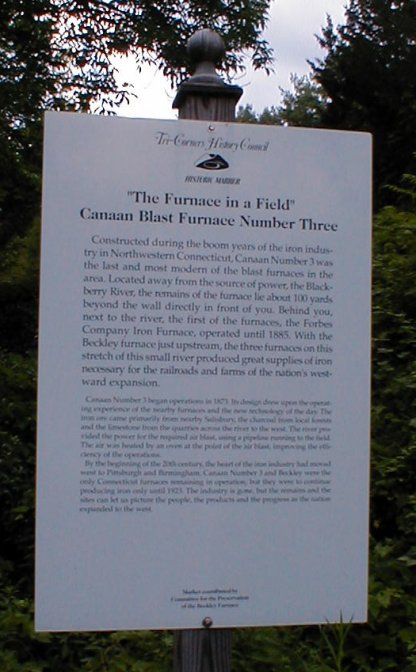 (Click on the photo to see more information about "The furnace in a
field" and East Canaan #1 from a sign on Lower Road).
(Click on the photo to see more information about "The furnace in a
field" and East Canaan #1 from a sign on Lower Road). |
||
|
|
||
|
|
||
|
Find us on Facebook |
|
Between the Lakes Group is located at 372 Between the Lakes Road, in Salisbury, Litchfield County, Connecticut. More specifically, we're in Taconic -- a hamlet in the Twin Lakes area of the Town of Salisbury. Questions about us or about our products? Go to our Frequently Asked Questions page.
|